Market City, 9-13 Hay St, Haymarket NSW 2000, Australia
Open daily 10:00 – 02:00
+61 2 9288 8900
+61 2 9288 8900
[email protected]
Market City, 9-13 Hay St, Haymarket NSW 2000, Australia
Open daily 10:00 – 02:00 · 18+ only

How a pachinko machine actually works

Guides Mar 12 8 min read

Everyone's watched the steel balls cascade. Far fewer know what's happening behind the glass. Our technician Dario opened one up and explained the whole system — the nails that shape your odds, the tulips that trigger jackpots and why two identical-looking machines can play completely differently.

Dario RossiMachine Technician · Mar 12

The ball's journey, top to bottom

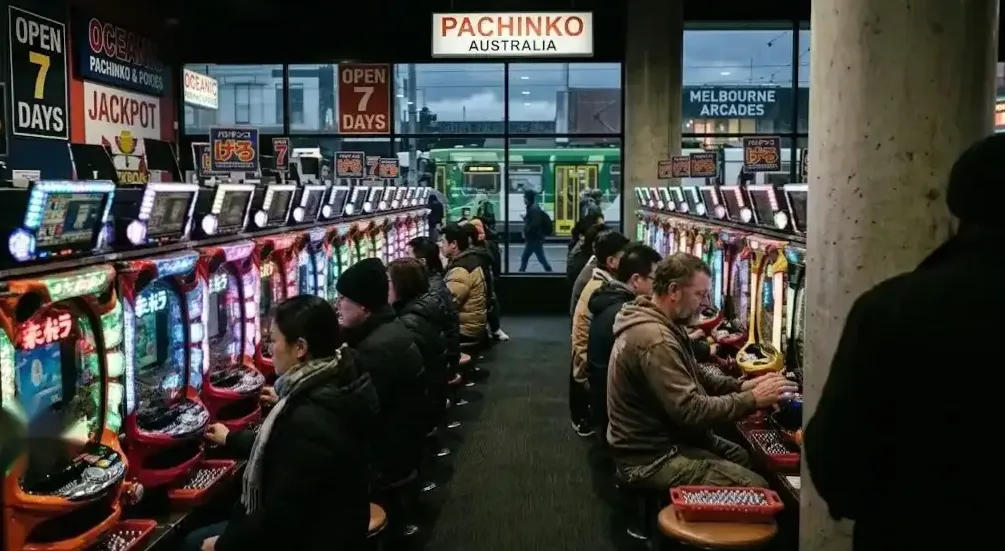
Every shot starts the same way: the launch knob feeds a single 11mm steel ball into the top rail, and gravity does the rest. The ball drops into a field of brass nails arranged in a pattern that's anything but random — the nail map is the machine's personality, deciding whether balls funnel toward the centre start pocket or scatter to the dead zones at the edges.

When a ball drops into the centre pocket, the machine's brain takes over. On modern units that means digital reels and a jackpot sequence on the central display; on vintage machines it's mechanical tulips and payout gates. Either way, the maths is the same — most balls are feedstock, a few are triggers.

How a pachinko machine actually works

People think the nails are decoration. They're the entire game. Change three nails and you've changed the machine's whole temperament.

The nail map is the machine's soul

Ask any serious player what they look at first and it's never the theme — it's the nails. Tightly-spaced nails near the centre pocket mean frequent small hits and steady play. A wider map feeds fewer balls through but builds toward bigger jackpot sequences.

Our calibration is deliberate. The 'friendly row' near the entrance runs generous nail settings so beginners see wins early. The high-limit machines in the lounge run tighter maps — fewer hits, bigger payoffs. Same game, different temperament.

Vintage units add another layer. A 1990s mechanical machine has no memory and no mercy — its behaviour is pure physics. Modern smart machines run programmed volatility curves, which is why a machine that feels 'cold' for an hour can suddenly open up.

Five things to check before you sit down

You don't need a workshop certificate to read a machine. Thirty seconds of inspection tells you most of what matters:

  • Look at the nail gap around the centre pocket — tight spacing means a stingier machine.
  • Check the machine's age — vintage units are pure physics, modern ones run programmed volatility.
  • Watch a player's ball flow for a minute — smooth central flow beats chaotic spray.
  • Find the row label — our floor marks friendly, standard and high-volatility rows.
  • Ask the host what's been paying — we track it nightly.

None of this guarantees a jackpot — nothing does. But it moves you from picking by theme to picking by temperament, which is the single biggest upgrade a casual player can make.

Five things to check before you sit down

Why this matters more than any 'system'

Every pachinko myth — lucky seats, hot machines, timing tricks — dies the moment you understand the hardware. What remains is real: nail maps, machine age, volatility and your own bankroll discipline.

Next time you're on the floor, ask a host to show you the nail map on your machine. They'll happily explain it — it's the most common question we get, and the one we enjoy answering most.

Key takeaways
The nail map controls everything — learn to read it before you play.
Vintage machines are pure physics; modern ones run programmed volatility.
Row labels on our floor mark friendly, standard and high-volatility machines.
No system beats the hardware — pick machines by temperament, not theme.
Dario RossiMachine Technician

Dario maintains and restores all 160-plus machines at the club, including the vintage row. He's rebuilt units dating back to 1978 and documents every teardown for the workshop log.

Quick answers

Common questions

The follow-ups we hear most on this topic.

Can you tell if a machine will pay out?

Nobody can predict a jackpot — but you can read a machine's temperament. Nail spacing, machine age and row type tell you whether it pays little-and-often or rarely-and-big.

Are older machines better?

Different, not better. Vintage units are pure mechanical physics — honest but unforgiving. Modern machines offer more features and programmed variety. Try both rows and see which suits you.

Do the club's machines take real money?

No — all our machines run on prepaid ball cards for amusement play. You win prize points, never cash, which keeps everything legal under NSW amusement-device rules.

Done reading

Come see the nail maps yourself.

The friendly row is open daily from 10am — hosts will walk you through any machine on the floor.